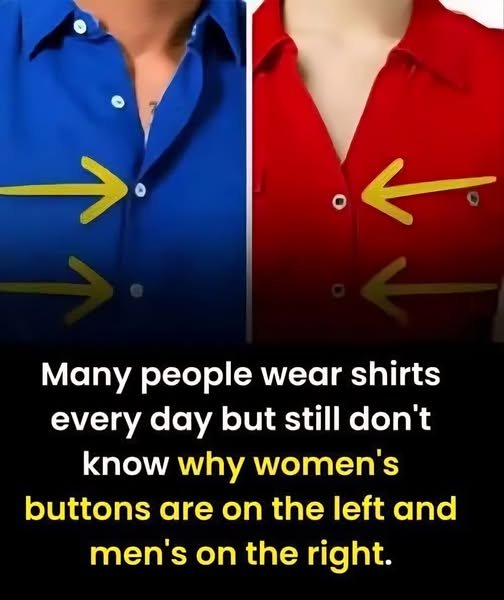
Why Women’s Shirts Button on the Left and Men’s on the Right: A Historical Fashion Tradition Rooted in European Class Structure, Servant-Assisted Dressing, and Practical Needs of Men Carrying Weapons, Showing How Centuries-Old Social Customs Became Standardized Into Modern Clothing Design and Still Persist Today as a Subtle Remnant of Historical Gender Roles

The difference in button placement between men’s and women’s shirts is a small detail that actually reflects a long history of social structure and clothing design. While modern clothing is mass-produced for convenience and style, many of its features come from older traditions that once had practical meaning. Clothing has always reflected how societies were organized, and even minor design choices can carry historical traces.

The most common explanation for women’s buttons being on the left side comes from upper-class Europe in the 18th and 19th centuries. Wealthy women often wore complex layered outfits and rarely dressed themselves. Since maids—usually right-handed—helped them dress, placing buttons on the left made fastening easier from an assistant’s perspective.

As fashion spread beyond aristocratic elites, these design choices were widely copied. Clothing was a symbol of status, so lower classes imitated upper-class styles. Later, industrial garment production standardized these patterns, preserving button placement conventions even after assisted dressing became uncommon.

Men’s clothing developed differently because men generally dressed themselves. Garments were designed for practicality and ease of movement. Some historians also note that men often carried weapons on the left side, so right-side buttoning supported accessibility and self-dressing efficiency.

Over time, the original reasons for these differences faded as societies changed. Servant-assisted dressing became rare, and weapons were no longer part of daily civilian life. However, the established clothing templates remained in place due to manufacturing habits and consumer expectations.

Once factories began mass-producing clothing, consistency mattered more than redesigning small details. Because people were already used to the distinction, manufacturers continued using the same button orientations, reinforcing them as “normal” rather than functional.

Today, the difference has little practical purpose. Most people dress independently, and clothing design focuses on comfort and style. Still, the convention persists as a quiet reminder of how historical practices can survive through repetition long after their original context disappears.

In this way, something as simple as shirt buttons becomes a subtle link to the past, showing how everyday objects can preserve traces of social history even when their original meaning is largely forgotten.

  • Related Posts

    • News
    • May 21, 2026
    • 2 views
    “Reign Check” Podcast: Inside the headlines of the British Royal Family

    The crown still glitters, but the truth beneath it rarely does. This isn’t a soft-focus celebration of royalty; it’s a sharp, addictive exploration of power, pressure, and image-making inside the…

    • News
    • May 21, 2026
    • 2 views
    The Terrifying Discovery in My Child’s Hair That Saved Her Life – The Hidden Medical Nightmare Every Parent Needs to Know About

    What began as a small, ordinary-looking spot on a child’s scalp quickly turned into every parent’s nightmare. At first, it resembled an insect bite or minor cyst, but a closer…

    Leave a Reply

    Your email address will not be published. Required fields are marked *

    You Missed

    “Reign Check” Podcast: Inside the headlines of the British Royal Family

    “Reign Check” Podcast: Inside the headlines of the British Royal Family

    The Terrifying Discovery in My Child’s Hair That Saved Her Life – The Hidden Medical Nightmare Every Parent Needs to Know About

    The Terrifying Discovery in My Child’s Hair That Saved Her Life – The Hidden Medical Nightmare Every Parent Needs to Know About

    The Number of Robins You See Reveals Who Walks By Your Side Explores Popular Symbolic Beliefs and Spiritual Interpretations Connected to Birds, Coincidences, and Nature Encounters, While Highlighting How People Often Attach Personal Meaning to Everyday Wildlife Sightings, and Why Psychologists Explain That Human Emotion, Memory, and Pattern Recognition Can Influence the Way These Experiences Are Interpreted in Daily Life

    The Number of Robins You See Reveals Who Walks By Your Side Explores Popular Symbolic Beliefs and Spiritual Interpretations Connected to Birds, Coincidences, and Nature Encounters, While Highlighting How People Often Attach Personal Meaning to Everyday Wildlife Sightings, and Why Psychologists Explain That Human Emotion, Memory, and Pattern Recognition Can Influence the Way These Experiences Are Interpreted in Daily Life

    When a Fresh Start Takes an Unexpected Turn A Family’s First Home Experience Unfolds Into a Journey of Surprises Challenges and Emotional Lessons That Come With Building a Life in a New Space While Learning About Patience Adaptation and the Realities Behind Turning a House Into a True Home Over Time

    When a Fresh Start Takes an Unexpected Turn A Family’s First Home Experience Unfolds Into a Journey of Surprises Challenges and Emotional Lessons That Come With Building a Life in a New Space While Learning About Patience Adaptation and the Realities Behind Turning a House Into a True Home Over Time

    What Is Bologna Made Of?

    What Is Bologna Made Of?

    Psychotherapist issues chilling prediction that Donald Trump will ‘kill more people than Hitler’

    Psychotherapist issues chilling prediction that Donald Trump will ‘kill more people than Hitler’