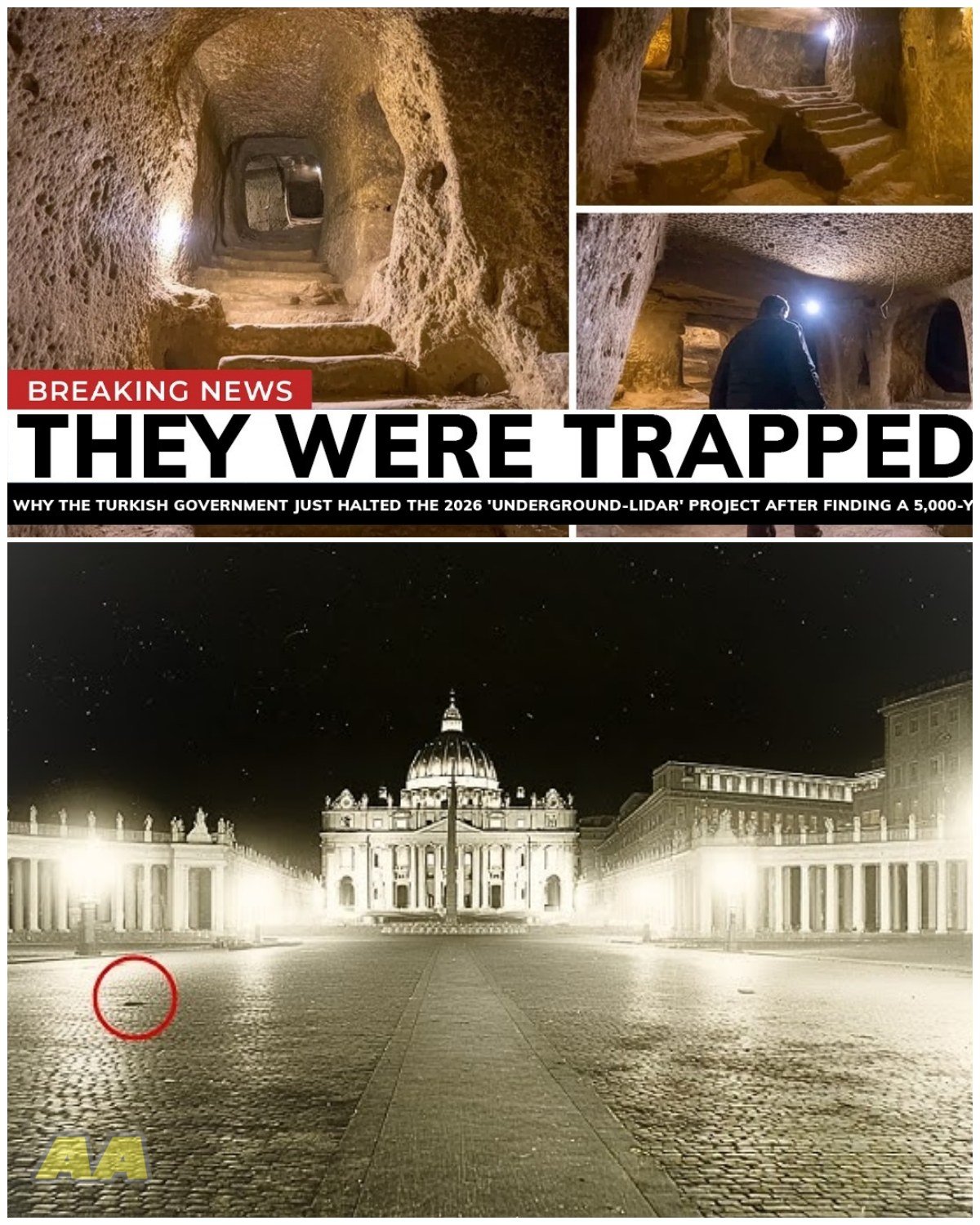
Beneath the Vatican: Mystery, History, and the Power of Silence
Beneath the grandeur of St. Peter’s Basilica lies a layered world few visitors ever see.
While millions admire the soaring dome and Renaissance artistry above ground, below exists a complex network of burial sites, corridors, and archaeological remains that stretch back thousands of years.
Some of these underground spaces are well documented.

The Vatican Necropolis—a Roman-era burial ground discovered during excavations in the 1940s—is one of the most significant.
Carefully preserved and partially accessible through guided tours, it offers a rare glimpse into the ancient past beneath the Vatican.
But beyond these known areas, questions begin to emerge.
Historical records confirm that Vatican Hill was once a vast Roman cemetery long before Christianity took root there.
When Emperor Constantine the Great ordered the construction of the original basilica in the 4th century, it was built directly over this necropolis.

Tombs were filled, leveled, and incorporated into the foundation—a decision that physically embedded layers of history beneath the structure.
Over centuries of construction, renovation, and expansion, workers repeatedly encountered deeper subterranean spaces—chambers, passages, and structural remains from earlier periods.
In many documented cases, these discoveries were not fully explored but instead sealed or built over.
This pattern has fueled speculation.

Some interpret these sealed spaces as evidence of hidden knowledge or suppressed discoveries.
Others, however, point to more practical explanations.
Archaeological excavation beneath a functioning religious and historical site is extraordinarily complex.
Structural stability, preservation concerns, and limited resources often require that certain areas remain untouched.
In fact, modern archaeology frequently prioritizes preservation over exploration.
Once a site is opened, it can be exposed to damage from air, moisture, and human activity.
Sealing certain areas may not indicate secrecy—it may reflect an effort to protect fragile historical layers for future generations with better technology.
Another factor is documentation.
Not every discovered space is fully mapped or published, especially in earlier centuries when record-keeping standards varied.
Gaps in documentation can create the impression of deliberate omission, even when the reality is simply incomplete historical records.
The conversation becomes even more complex when considering the Vatican Apostolic Archives.
Often described as one of the most extensive historical archives in the world, it contains centuries of documents related to church governance, diplomacy, and history.
Access to these archives is restricted, but not unusual by global standards.
Many large archives—especially those containing sensitive or fragile materials—require researchers to apply in advance and specify their areas of study.
While this controlled access can feel limiting, it is generally intended to preserve documents and manage an immense collection rather than conceal specific secrets.
Still, the combination of sealed underground spaces and restricted archives has contributed to a powerful narrative: that something significant lies hidden beneath the Vatican.
Historically, however, there is a broader context to consider.
Many of the world’s most important religious sites were built atop earlier sacred locations.
This pattern appears across cultures—from ancient temples to medieval cathedrals.
The continuity of sacred geography reflects how successive civilizations adopted and reinterpreted meaningful places rather than abandoning them.
In this sense, the Vatican is not unique.
It is part of a long tradition of layering belief systems over earlier foundations.
Yet, the mystery persists.
What lies beneath the deepest layers of Vatican Hill remains only partially understood.
Archaeological work is limited, access is controlled, and much of the underground remains unexplored or undocumented in publicly available sources.
This does not necessarily point to hidden artifacts or extraordinary discoveries.
But it does highlight something more subtle—and perhaps more compelling.
Control of access shapes understanding.
Institutions, whether religious, academic, or governmental, inevitably influence how knowledge is shared.
Decisions about what to preserve, what to study, and what to publish determine how history is interpreted by future generations.
In the case of the Vatican, that control has been exercised over centuries—through architecture, archives, and careful management of one of the most historically significant sites on Earth.
So the real question may not be whether something extraordinary is hidden beneath the Vatican.
It may be why certain spaces remain out of reach—and how that distance shapes the stories we tell about what lies below.
Because sometimes, the most powerful mystery is not what is hidden…but what is left unexplained.