Face of a Pharaoh: When DNA Brings Ancient Egypt Back to Life
Inside a carefully controlled laboratory, far removed from the sands of Egypt, a remarkable scientific journey began with something deceptively small—a single ancient tooth.
It once belonged to a man who ruled along the Nile more than 3,000 years ago.
His tomb had been disturbed, his identity obscured by time, yet within that fragment remained a powerful key: his DNA.
What followed was not just an archaeological investigation, but a technological resurrection.

The story traces back to 1898, when French archaeologist Victor Loret uncovered tomb KV35 in the Valley of the Kings.
Among the remains were several royal mummies, including one whose identity could not be clearly determined.
With inscriptions damaged and burial contexts disrupted, the individual became one of many lost figures of Egypt’s past—anonymous, yet undeniably significant.
For over a century, the mystery remained unsolved.
Then came a new kind of archaeology—molecular archaeology.

By the early 21st century, scientists began extracting ancient DNA (aDNA) from preserved remains.
In this case, the tooth became the focal point.
Within its pulp lay genetic fragments that had survived millennia, though barely intact.
Working under sterile conditions to avoid contamination, researchers carefully sequenced these fragments using advanced genomic technology.
Ancient DNA is notoriously fragile, often degraded into tiny pieces, but with modern methods, even these fragments can be reconstructed into meaningful genetic data.
The results were extraordinary.
Initial analysis placed the individual within Egypt’s 18th Dynasty, a period that included some of the most iconic figures in ancient history—Akhenaten, Amenhotep III, and Tutankhamun.
Yet the genetic profile did not perfectly match any known royal lineage.
Instead, it revealed a more complex ancestry than previously assumed.
The genome showed a mixture of traits associated with populations from Upper Egypt and the Levant—a region encompassing parts of the modern Middle East.
This suggested that royal bloodlines were not as isolated as once believed.
Instead, they were shaped by movement, interaction, and exchange across regions.
This finding aligns with what historians know about ancient Egypt’s position as a cultural crossroads.
Trade, diplomacy, and even conquest brought different peoples into contact along the Nile.
Over generations, these interactions left their mark not just on culture, but on DNA.
But the most striking part of the project was yet to come.
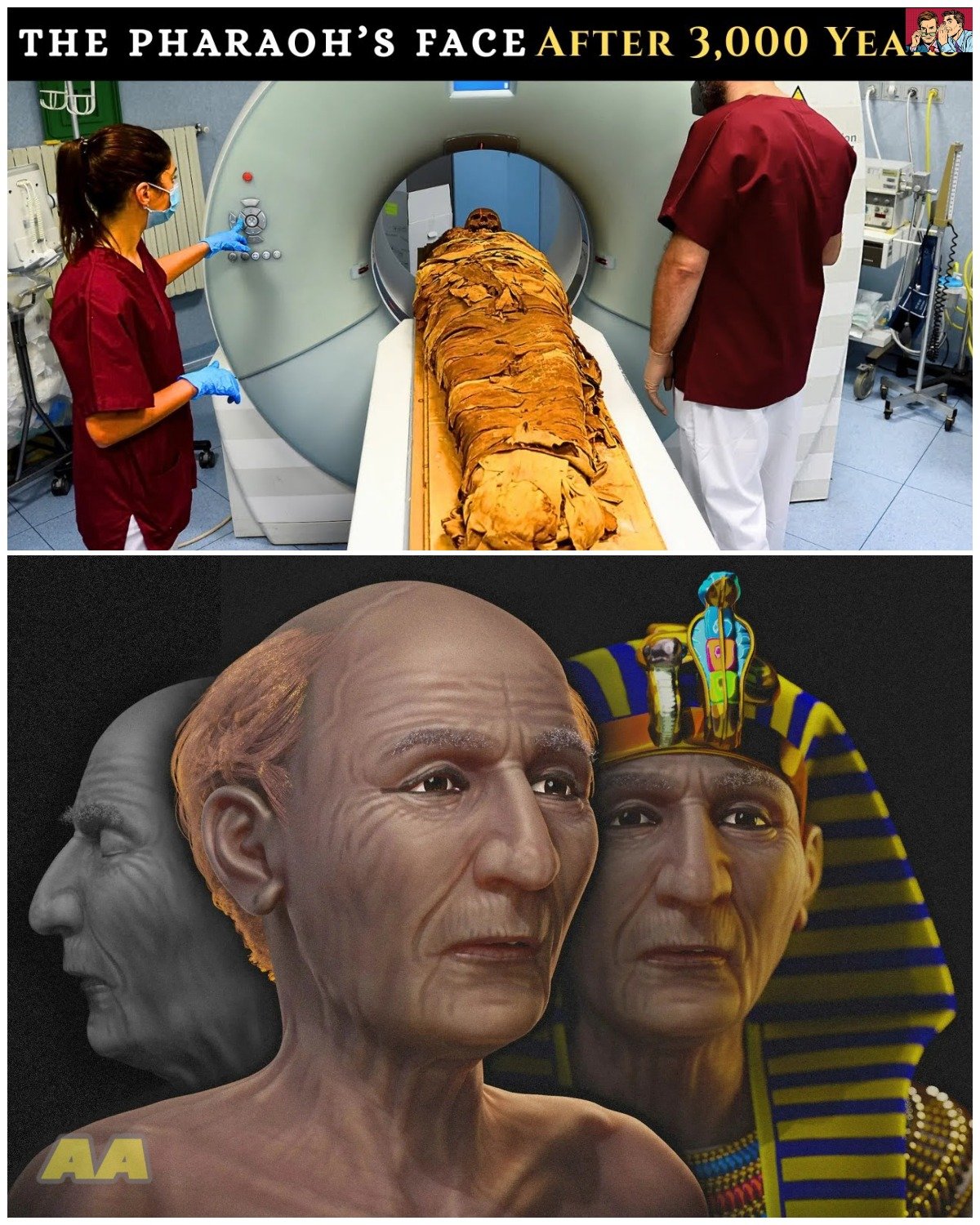
Using a combination of genetic data and CT scans of the skull, scientists began reconstructing the pharaoh’s face.
This process, known as forensic facial reconstruction, relies on precise anatomical measurements rather than artistic interpretation.
Each muscle, layer of tissue, and facial feature is built upon the underlying bone structure.
Advanced algorithms helped estimate skin tone, eye color, and hair characteristics based on genetic markers.
The result was a face that felt both ancient and startlingly modern.
The reconstructed pharaoh did not resemble the idealized figures seen in temple carvings.
Instead, he appeared human—distinct, imperfect, and real.
Subtle asymmetries, fine lines, and natural proportions replaced the stylized perfection of royal art.
Even more surprising were the genetic traits revealed through analysis.
The pharaoh likely had an olive-toned complexion, dark eyes, and brown hair with a finer texture than often depicted in traditional imagery.
His features reflected a blend of influences, challenging simplified narratives about ancient Egyptian identity.
Rather than fitting into rigid modern categories, his DNA told a more nuanced story—one of connection between Africa and the Near East, shaped over centuries of interaction.
This has broader implications for how we understand ancient Egypt.
For years, debates about the origins and identity of Egyptian rulers have often been framed in narrow terms.
But genetic evidence paints a different picture.
Egypt was not isolated—it was dynamic, interconnected, and constantly evolving.
Its people, including its rulers, reflected that complexity.
At the same time, the DNA revealed another layer of truth—one less visible, but equally important.
Genetic markers suggested potential health vulnerabilities within royal lineages.
Traits linked to bone disorders, immune challenges, and other conditions hinted at the biological cost of maintaining dynastic continuity.
Royal families often practiced selective marriages to preserve power, but this may have led to reduced genetic diversity over time.
Beneath the grandeur of temples and monuments, there were human limitations—fragility hidden within the bloodlines of kings.
Ironically, the very process meant to preserve the body for eternity—mummification—also damaged much of the DNA scientists now rely on.
Chemicals used in embalming degraded genetic material, leaving only fragments behind.
Yet those fragments proved enough.
From broken strands of DNA, researchers reconstructed not just a face, but a story.
A man once worshipped as divine is now understood through data, biology, and science.
His identity, once lost, has been partially restored—not through myth, but through evidence.
Today, as his reconstructed face looks back across millennia, it offers something rare: a direct, human connection to the past.
Not a symbol.
Not an icon.
But a person.
And perhaps that is the most powerful revelation of all.
Ancient Egypt was not built by gods—it was built by people whose lives, identities, and even genetic struggles were far more relatable than history once suggested.
Through DNA, their voices are beginning to speak again.