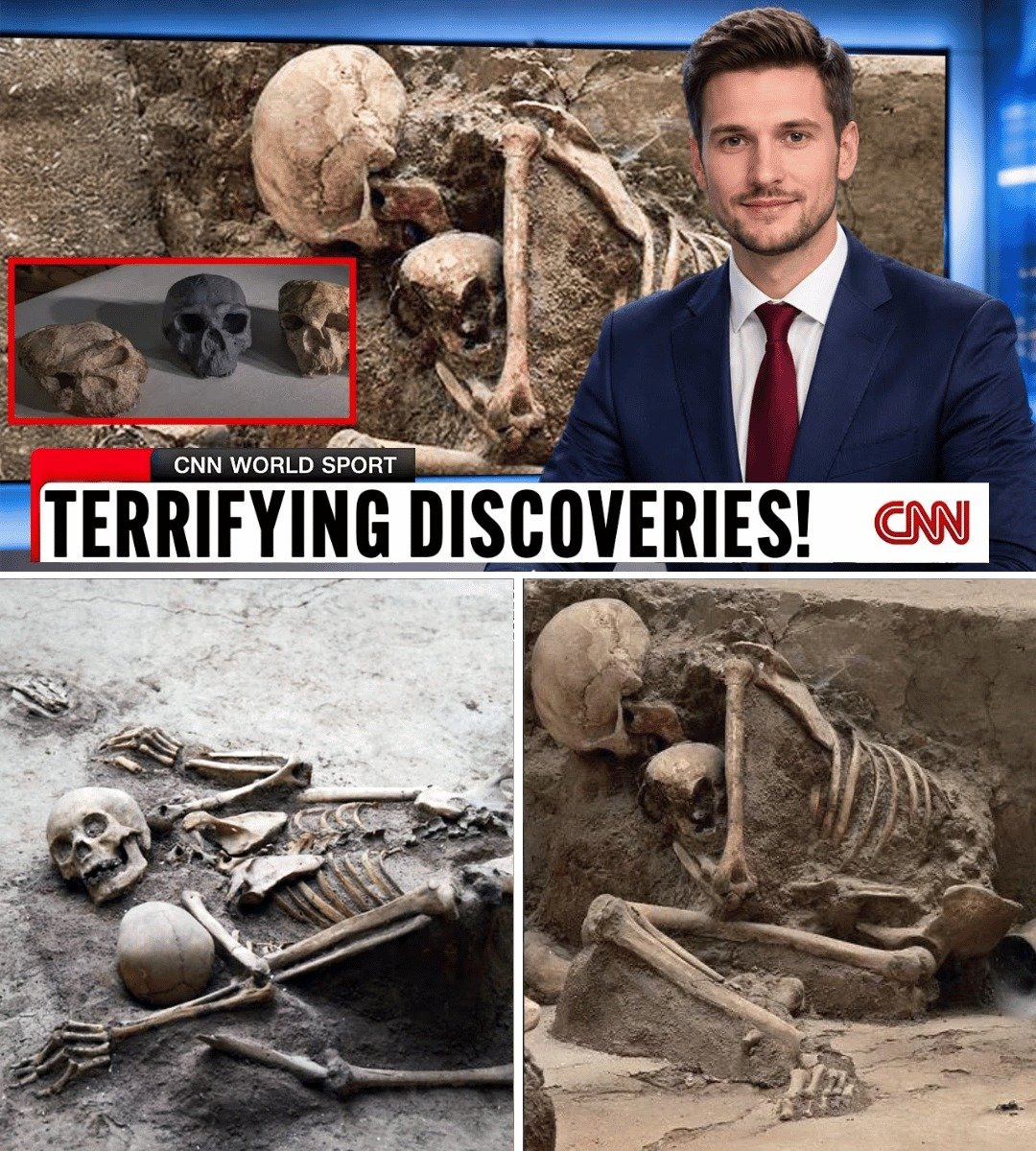
A groundbreaking discovery has emerged from ancient China: a 4,000-year-old human skeleton whose DNA shares no clear link to any known species on Earth. This unprecedented finding challenges established narratives about human evolution and raises urgent questions about our deepest ancestral roots and the hidden complexity of early civilizations.

During a routine excavation tied to a prehistoric settlement in China, archaeologists uncovered skeletal remains dated to roughly 4,000 years ago. At first glance, everything seemed ordinary—the bones conformed to human anatomy, burial customs matched known practices, and the surrounding artifacts reflected a community well-rooted in its era.
However, the real shock came with genetic testing. Scientists painstakingly extracted ancient DNA from the bones, a delicate process given degradation over millennia. The genetic sequences defied expectations, showing markers that did not align with any modern or ancient human populations catalogued in scientific databases.
This revelation is not an announcement of some alien life form but a testament to the vast gaps in our understanding of human history. The skeleton’s DNA represents a lineage that has seemingly vanished, lost amid waves of migrations, cultural shifts, and environmental changes that reshaped East Asia long before written records.
Ancient DNA is notoriously fragmented and elusive, often surviving only in dense bones or teeth. Researchers piece together these genetic fragments by comparing them against known modern and ancient genomes. When matches falter, it signals missing chapters—not impossibilities—in the human story.
The 4,000-year-old individual lived during a transformative period in East Asia. Farming was spreading, tools evolving, and societies becoming more complex. Local communities thrived and vanished, often absorbed or replaced by others, leaving subtle or erased genetic traces that confuse today’s scientific lens.
East Asia’s genetic landscape from millennia ago was incredibly diverse and fluid. Unlike today’s defined nations and ethnic groups, ancient populations shifted with rivers, climate, and resources. Natural barriers like mountains and deserts fragmented gene pools, while migration and intermarriage layered genetic signals into a complex mosaic.
Modern genetic maps reflect survivors, not all who ever lived. Entire ancient lineages disappeared or merged beyond recognition. The skeleton’s genome is a vivid reminder of this lost diversity—a puzzle piece illuminating a broader, more nuanced picture of human ancestry in the region.
Far from a scientific anomaly, this discovery sparks renewed attention on ancient Chinese genetic history’s depth and complexity. It exposes how continuous occupation coexisted with frequent demographic upheavals, migration-driven assimilation, and regional differentiation stretching back tens of thousands of years.
This skeleton’s DNA challenges simplistic narratives by revealing a snapshot of a world in transition. What seems alien now was once locally ordinary, before future migrations and social changes narrowed the genetic branches visible today. It underscores the ever-changing nature of human origins.

The burial context reinforces the individual’s humanity. Grave goods and positioning align with known prehistoric customs, indicating social integration and cultural continuity. The discovery reminds us that genetics alone cannot define identity; cultural and social frameworks are essential to understanding ancient lives.
Ancient DNA does more than decode genes—it resurrects lost voices. Each genome is a fragment of history, echoing migrations, adaptations, and interactions previously invisible. The 4,000-year-old skeleton bridges past and present, inviting deeper inquiry into human diversity and challenging assumptions about genetic uniformity.
Lost lineages are not enigmas but expected byproducts of millennia of movement and change. The genome reveals patterns erased by assimilation, disease, and environmental pressures—those threads woven into the vast tapestry of human survival and adaptation that science is only beginning to unravel.
The expansive geography of ancient China shaped genetic differentiation. River valleys nourished distinct communities, while natural barriers fostered isolation and unique genetic profiles. Over time, expansions of agricultural societies layered over previous populations, reshuffling and diluting ancient lineages into the modern gene pool.
Migration did not move in straight lines but swirled and reversed with shifting climates and resources. The skeleton’s genome captures a fleeting intermediate phase—neither fully ancient nor modern—reflecting how dynamic prehistoric populations were and how quickly identities could transform or vanish.
China’s long continuity of human occupation is a paradox of persistence and flux. The genetic record embodies slow, relentless change punctuated by expansions, invasions, and cultural shifts. The skeleton’s unfamiliar DNA sheds light on the complexity hidden beneath the surface of cultural continuity.
Language, culture, and population movements further layered genetic patterns. Linguistic expansions sometimes outpaced gene flow, allowing cultural identity to shift while genetic ancestry retained older signatures. This decoupling complicates efforts to neatly categorize ancient genomes and enriches our grasp of human social evolution.
Neighboring migrations from Central Asia, Siberia, and Southeast Asia infused additional genetic diversity into East Asia’s melting pot. Some left faint marks, others deeply integrated. Such mixing challenges the concept of pure lineages, illustrating a history of constant human interaction and exchange.
The fragmentary nature of ancient DNA demands caution. Early interpretations of uniqueness often dissolve with more data. Isolated genomes frequently connect to broader networks of populations previously unknown or blurred. This evolving understanding spotlights the provisional nature of scientific knowledge.
This finding underscores the power of archaeology and genetics combined. Bones reveal diet, labor, and social structures; DNA adds lineage and migration stories. Together, they humanize the dead while expanding our comprehension of humanity’s vast and intricate saga.
Far from sensationalizing mystery, scientists emphasize humility and inquiry. Each new genome retrieved is a question posed to history, prompting reflection on how populations formed, mingled, and sometimes faded—stories of everyday people that history almost forgot completely.
The skeleton’s genetic voice reminds us that human identity is never static. It twists through time, shaped by countless lives and choices. Ancient genomes offer a lens into moments of convergence and divergence, challenging linear ancestry models and enriching the global narrative.
As research progresses, more such discoveries will doubtless emerge, filling gaps and reshaping perspectives. The study of ancient Chinese DNA is a frontier promising to unlock untold stories, complicating assumptions about civilization, genetics, and the ancient human journey.
This groundbreaking find catalyzes an urgent call to expand archaeological and genomic investigations. The past is far from fully uncovered, and each fragmentary discovery offers crucial insight into humanity’s origins, diversity, and enduring resilience.
The 4,000-year-old skeleton does not represent an isolated anomaly but a profound chapter in human history. It compels us to rethink continuous civilization narratives and embrace a richer, more diverse human past shaped by endless migration, adaptation, and survival
DNA evidence from this ancient individual counters simplistic concepts of uniformity, reminding us that beneath every modern population lies a complex web of ancestors—some forgotten, some unknown—whose stories await discovery and understanding through ongoing scientific endeavor.

This remarkable genetic snapshot is a powerful invitation to deepen our understanding of early East Asia’s peoples, their movements, and their interactions. It closes few doors but opens many, shining light on the shadowed corridors of human history.
The skeleton’s discovery resonates beyond academia. It challenges popular myths of human uniqueness and sparks public fascination, urging a more nuanced appreciation of ancestral diversity and the complex interweaving of past lives shaping our present identity.
In tracing these ancient genetic echoes, we confront the limits of current knowledge and the vastness of what remains to be uncovered. The story of this individual is but one rhythm in the multifaceted symphony of human evolution and dispersal.
As researchers continue decoding fragments like this skeleton’s DNA, we gain not only genealogical data but also a profound connection to the human experience—its fragility, persistence, and unending complexity stretching back thousands of years.
This extraordinary find marks a milestone in ancient DNA research, expanding horizons and challenging existing frameworks. It demands careful interpretation and ongoing exploration, embracing uncertainty as a catalyst for deeper, more informed inquiry.
Far from alien or nonhuman, the skeleton’s genome exemplifies humanity’s diverse heritage. It is a testament to lost communities, silent histories, and the enduring power of science to uncover stories buried beneath layers of time.
The revelation redefines what ancient DNA can teach us and underscores the importance of interdisciplinary collaboration in archaeology, genetics, and anthropology to build a fuller picture of our shared past.
In unraveling the mystery behind this skeleton, we are reminded that human origins are not fixed points but evolving stories—complex, intertwined, and richer than ever imagined.
The research continues, promising more surprises and insights. Each ancient genome recovered stitches together fragments of the mosaic that is human history, transforming mystery into understanding and silence into narrative.
Stay tuned as science delves deeper into these ancient secrets, unveiling the hidden diversity of our ancestors and reshaping the story of human evolution forever.