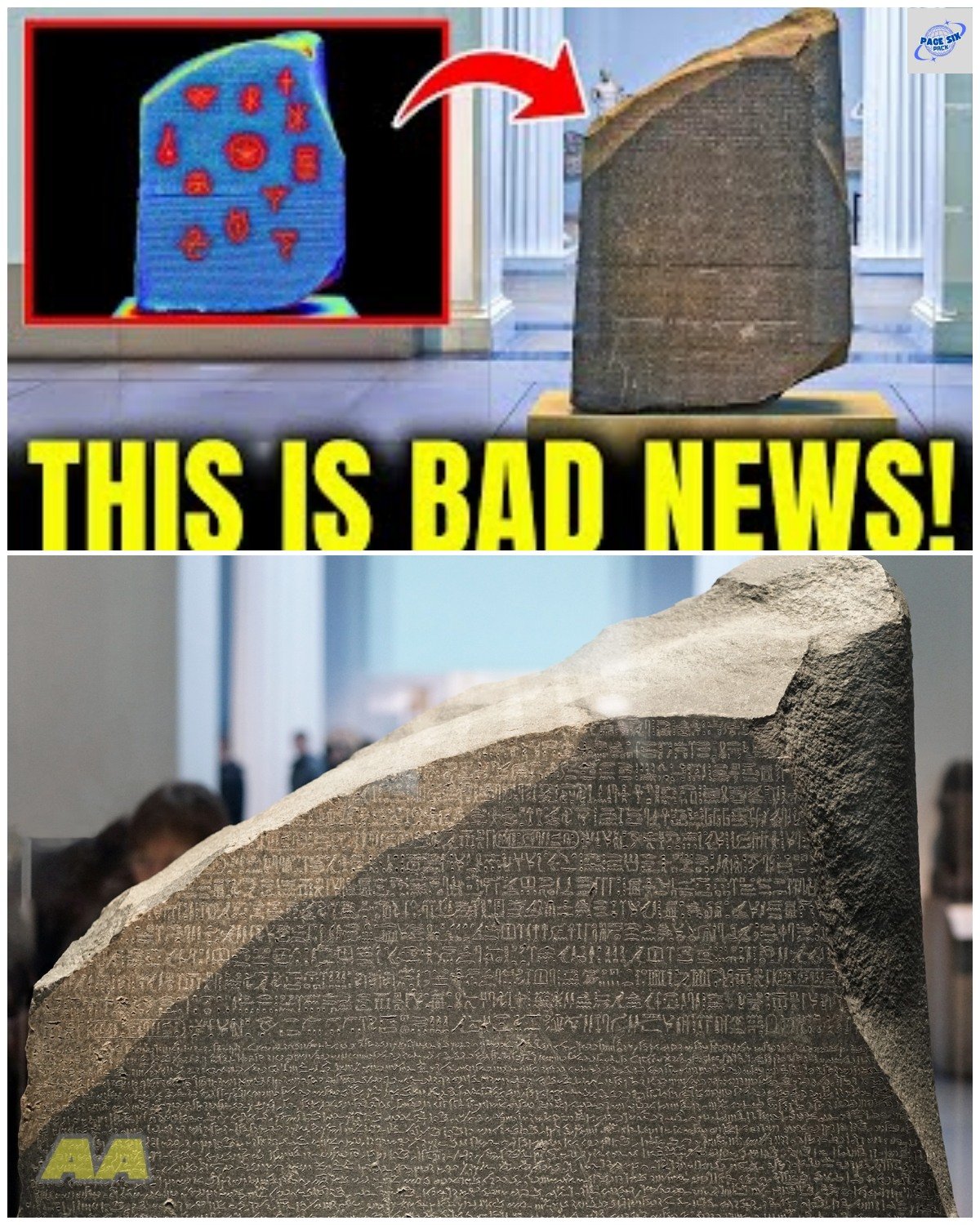
Decoded Secrets: Is the Rosetta Stone Hiding More Than History?
For over two millennia, a single carved stone has stood at the crossroads of language, history, and mystery.
Known as the Rosetta Stone, this artifact has long been celebrated as the breakthrough that allowed humanity to finally understand the written language of ancient Egypt.
Yet today, new technological insights are reopening a question once thought settled: have we truly decoded everything it contains?

Discovered in 1799 by French soldiers near the Egyptian town of Rosetta, the stone initially appeared unremarkable—a fragment of dark granodiorite etched with unfamiliar symbols.
But its importance quickly became clear.
What made it extraordinary was not just the writing itself, but the fact that the same message appeared in three distinct scripts.
The upper portion was written in hieroglyphics, the sacred script used in temples and monuments.
Beneath it lay Demotic, the everyday script of ancient Egyptian society.

At the bottom was Ancient Greek, a language scholars could already understand.
This trilingual format would become the key that unlocked a civilization’s lost voice.
For centuries prior, Egyptian hieroglyphs had remained an enigma.
They adorned temples, tombs, and statues across Egypt, yet no one alive could read them.
The Rosetta Stone changed that forever.
In 1822, French linguist Jean-François Champollion achieved what generations before him could not.
By comparing the Greek text with the Egyptian scripts, he successfully deciphered hieroglyphics, restoring a long-silent language to life.
It was one of the greatest intellectual breakthroughs in human history.
Once translated, the message on the stone appeared straightforward.
It was a royal decree issued in honor of King Ptolemy V, praising his rule and granting privileges to temples.
For decades, this explanation remained uncontested.
The Rosetta Stone was important not because of what it said, but because it allowed everything else to be understood.
Case closed—or so it seemed.
In recent years, however, advances in artificial intelligence have prompted researchers to revisit the stone with fresh eyes.
Unlike human scholars, AI systems can analyze vast amounts of linguistic data simultaneously, detecting subtle patterns, repetitions, and structural anomalies that might otherwise go unnoticed.
What they found has sparked new debate.
Certain phrases within the text appear to follow unusual patterns.
Some lines seem to carry layered meanings—interpretations that shift depending on how they are read or which script is emphasized.
This raises a fascinating possibility: the inscription may not be as simple as once believed.
In ancient Egypt, such complexity would not have been unusual.
Scribes were highly trained, often capable of embedding multiple levels of meaning within a single text.
A message could function on the surface as an official decree, while simultaneously conveying deeper symbolic, religious, or political ideas to a more educated audience.
If this interpretation is correct, the Rosetta Stone may have served more than one purpose.
It may have been designed not only to communicate authority, but also to encode subtle messages—perhaps even ones intended to remain hidden from most readers.
Some researchers suggest these patterns could reflect political strategy, reinforcing the legitimacy of Ptolemy V in a culturally diverse society.
Others speculate about hidden religious symbolism or coded diplomatic signals embedded within the text.
Yet not everyone is convinced.
Skeptics argue that artificial intelligence, while powerful, is not infallible.
Pattern recognition algorithms can sometimes identify connections that are purely coincidental.
What appears to be a hidden meaning might simply be the natural structure of language or the result of translation differences between scripts.
This tension between discovery and caution highlights a broader challenge in modern research: how to interpret findings produced by machines that can see more than humans—but may not always understand context the same way.
Still, one fact remains undeniable.
The Rosetta Stone continues to surprise us.
More than 2,200 years after it was carved, and over two centuries after it was first deciphered, it refuses to be fully understood.
What was once considered a solved puzzle now appears, once again, to contain unanswered questions.
This evolving perspective transforms the stone from a finished chapter of history into an ongoing investigation.
It reminds us that even our most celebrated discoveries may still hold hidden depths, waiting for new tools—and new ways of thinking—to bring them to light.
Perhaps the most intriguing possibility is not that the Rosetta Stone contains secrets, but that it was always meant to.
That ancient Egyptian scribes, aware of language’s power, deliberately crafted a message that could speak differently across time, culture, and understanding.
If so, we may only now be beginning to hear what they intended.
And somewhere within those ancient carvings—between the hieroglyphs, the Demotic script, and the Greek text—there may still be meanings that have yet to fully emerge.