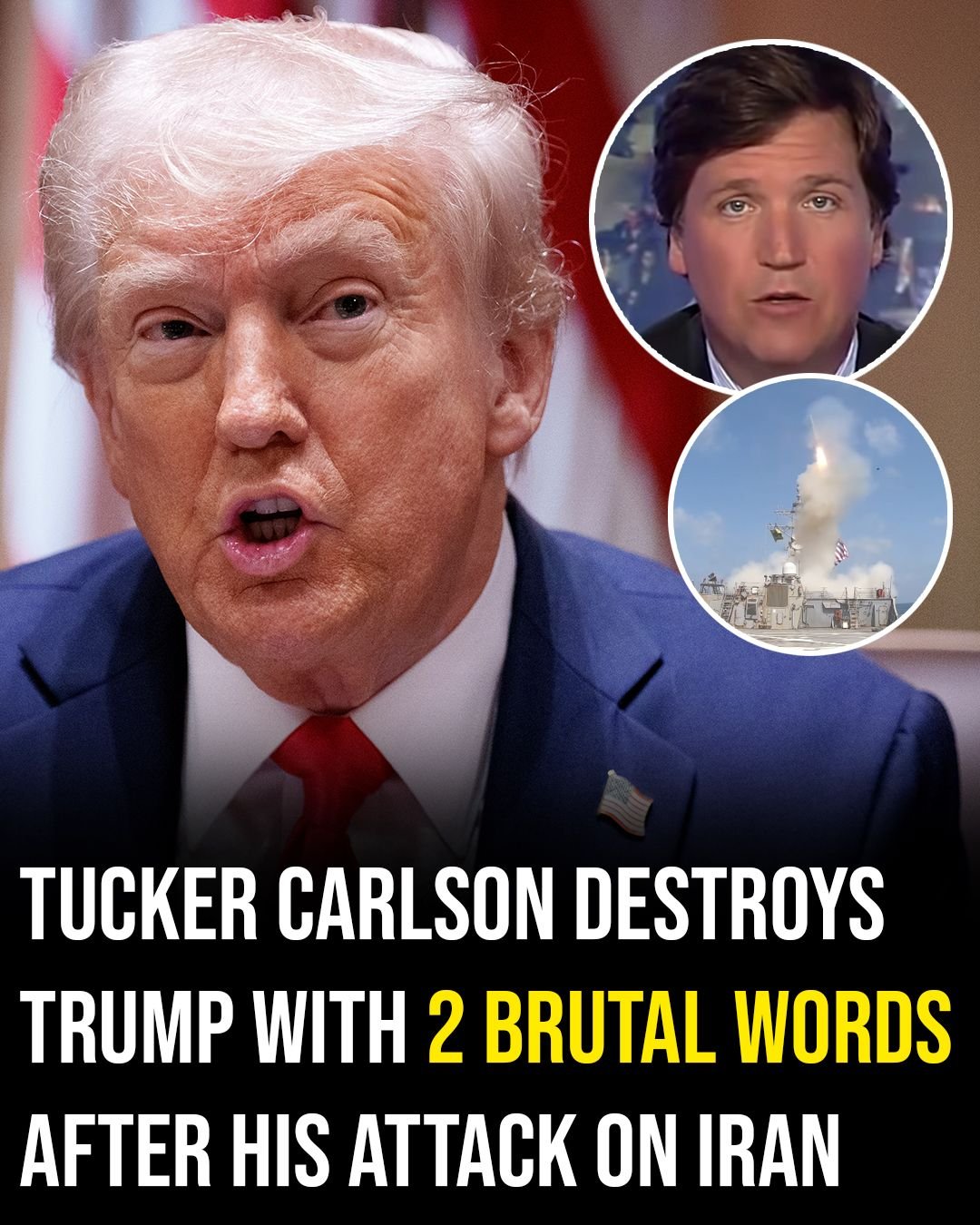
Tucker Carlson slams Trump with 2 brutal words after his attack on Iran!The geopolitical landscape has been thrust into a state of profound instability following a series of coordinated military strikes by Israel and the United States against Iranian positions. This operation, while framed by the administration as a decisive victory for national security, has triggered a seismic shift in the American political dialogue, exposing deep and perhaps irreparable fractures within Donald Trump’s conservative base. The strikes, which targeted Tehran on February 28, resulted in the reported death of Iran’s Supreme Leader, Ayatollah Ali Khamenei, along with dozens of senior officials—an escalation that represents one of the most direct and consequential confrontations between Washington and Tehran in modern history. In an interview following the operation, President Trump described the campaign as “highly successful,” remarking on the speed and precision of the strikes. He noted that nearly fifty leaders had been eliminated in a single coordinated effort, characterizing the mission as a necessary conclusion to a conflict that has persisted for nearly half a century. However, the triumphalism of the administration was quickly met with a sobering reality as the U.S. Central Command confirmed the loss of three American service members, with five others seriously wounded. The immediate aftermath saw a barrage of retaliatory missile and drone strikes from Iranian forces targeting U.S. military installations throughout the Gulf, including critical bases in Bahrain, Qatar, and Dubai. Despite the escalating violence and the human cost, the President has remained steadfast, asserting that combat operations will persist until every strategic objective is fulfilled. He issued a stark ultimatum to remaining Iranian security forces: lay down arms for immunity or face “certain death.” The administration’s core argument rests on the belief that an Iran equipped with long-range ballistic missiles and nuclear potential is a threat that can no longer be contained through diplomacy or sanctions. Yet, it is this very move toward total military engagement that has ignited a firestorm of criticism from voices that were once the President’s staunchest allies. The backlash within the conservative movement has been swift and remarkably severe. Leading the charge is independent journalist Tucker Carlson, whose departure from traditional media has only amplified his influence among the “America First” constituency. Carlson, who has historically defended the President’s domestic and trade agendas, chose uncharacteristically harsh language to condemn the strikes. Describing the decision as “absolutely disgusting and evil,” Carlson revealed that he had personally urged the President to show restraint during a private meeting just before the authorization. His critique suggests that for a significant portion of the base, the pivot from isolationism to high-intensity intervention is viewed as a betrayal of the movement’s founding principles. This sentiment was echoed by former congresswoman Marjorie Taylor Greene, who pointed to the scars of previous conflicts as a reason to reject the current path. She challenged the administration’s framing of the war as a “liberation” of the Iranian people, dismissing the idea that American blood and treasure should be spent on the internal political destiny of a foreign nation. For Greene and her supporters, the memory of “never-ending, pointless foreign wars” is a primary motivator, and the promise of a swift victory in Tehran feels like a dangerous echo of past miscalculations. The debate has also moved into the realm of constitutional law, with Senator Rand Paul raising the alarm over the expansion of executive power. Paul emphasized that the authority to initiate war resides solely with Congress—a check designed specifically to prevent the very type of rapid escalation currently unfolding in the Middle East. While expressing a “pure instinct” for the safety of the troops, his oath to the Constitution forced a public opposition to what he labeled “another Presidential war.” This constitutionalist critique highlights a growing concern that the executive branch is bypassing the democratic safeguards intended to prevent unilateral military action.


  • News
  • March 16, 2026

The geopolitical landscape has been thrust into a state of profound instability following a series of coordinated military strikes by Israel and the United States against Iranian positions. This operation, while framed by the administration as a decisive victory for national security, has triggered a seismic shift in the American political dialogue, exposing deep and perhaps irreparable fractures within Donald Trump’s conservative base.

The strikes, which targeted Tehran on February 28, resulted in the reported death of Iran’s Supreme Leader, Ayatollah Ali Khamenei, along with dozens of senior officials—an escalation that represents one of the most direct and consequential confrontations between Washington and Tehran in modern history.

In an interview following the operation, President Trump described the campaign as “highly successful,” remarking on the speed and precision of the strikes. He noted that nearly fifty leaders had been eliminated in a single coordinated effort, characterizing the mission as a necessary conclusion to a conflict that has persisted for nearly half a century. However, the triumphalism of the administration was quickly met with a sobering reality as the U.S. Central Command confirmed the loss of three American service members, with five others seriously wounded. The immediate aftermath saw a barrage of retaliatory missile and drone strikes from Iranian forces targeting U.S. military installations throughout the Gulf, including critical bases in Bahrain, Qatar, and Dubai.

Despite the escalating violence and the human cost, the President has remained steadfast, asserting that combat operations will persist until every strategic objective is fulfilled. He issued a stark ultimatum to remaining Iranian security forces: lay down arms for immunity or face “certain death.” The administration’s core argument rests on the belief that an Iran equipped with long-range ballistic missiles and nuclear potential is a threat that can no longer be contained through diplomacy or sanctions. Yet, it is this very move toward total military engagement that has ignited a firestorm of criticism from voices that were once the President’s staunchest allies.

The backlash within the conservative movement has been swift and remarkably severe. Leading the charge is independent journalist Tucker Carlson, whose departure from traditional media has only amplified his influence among the “America First” constituency. Carlson, who has historically defended the President’s domestic and trade agendas, chose uncharacteristically harsh language to condemn the strikes. Describing the decision as “absolutely disgusting and evil,” Carlson revealed that he had personally urged the President to show restraint during a private meeting just before the authorization. His critique suggests that for a significant portion of the base, the pivot from isolationism to high-intensity intervention is viewed as a betrayal of the movement’s founding principles.

This sentiment was echoed by former congresswoman Marjorie Taylor Greene, who pointed to the scars of previous conflicts as a reason to reject the current path. She challenged the administration’s framing of the war as a “liberation” of the Iranian people, dismissing the idea that American blood and treasure should be spent on the internal political destiny of a foreign nation. For Greene and her supporters, the memory of “never-ending, pointless foreign wars” is a primary motivator, and the promise of a swift victory in Tehran feels like a dangerous echo of past miscalculations.

The debate has also moved into the realm of constitutional law, with Senator Rand Paul raising the alarm over the expansion of executive power. Paul emphasized that the authority to initiate war resides solely with Congress—a check designed specifically to prevent the very type of rapid escalation currently unfolding in the Middle East. While expressing a “pure instinct” for the safety of the troops, his oath to the Constitution forced a public opposition to what he labeled “another Presidential war.” This constitutionalist critique highlights a growing concern that the executive branch is bypassing the democratic safeguards intended to prevent unilateral military action.

  • Related Posts

    • News
    • March 27, 2026
    • 2 views
    A Young Rider’s Unexpected Lesson During Motorcycle Practice

    Young Man Injured While Practicing Motorcycle Riding A young man who was reportedly learning how to ride a motorcycle has been involved in a serious accident, according to initial reports…

    • News
    • March 27, 2026
    • 3 views
    Shocking Simulation Reveals What Really Happens To Your Body After 30 Days Of Smoking Weed

    The YouTube video showed how weed impacts your mind and body after just one month of use A viral video has been making the rounds online, breaking down what actually…

    Leave a Reply

    Your email address will not be published. Required fields are marked *

    You Missed

    A Young Rider’s Unexpected Lesson During Motorcycle Practice

    A Young Rider’s Unexpected Lesson During Motorcycle Practice

    Shocking Simulation Reveals What Really Happens To Your Body After 30 Days Of Smoking Weed

    Shocking Simulation Reveals What Really Happens To Your Body After 30 Days Of Smoking Weed

    If You Spot This Near a Sink, This Is What It’s For

    If You Spot This Near a Sink, This Is What It’s For

    Bully Suckerpunches Cheerleader Who Doesn’t Want To Fight, Gets Instant Dose Of Karma

    Bully Suckerpunches Cheerleader Who Doesn’t Want To Fight, Gets Instant Dose Of Karma

    Harrowing Final Words Of Man Before He And Girlfriend Were Eaten Alive By Bear On Camera

    Harrowing Final Words Of Man Before He And Girlfriend Were Eaten Alive By Bear On Camera

    Construction Worker Turns Blue Overnight, Doctors ‘Laugh’ at the Cause

    Construction Worker Turns Blue Overnight, Doctors ‘Laugh’ at the Cause