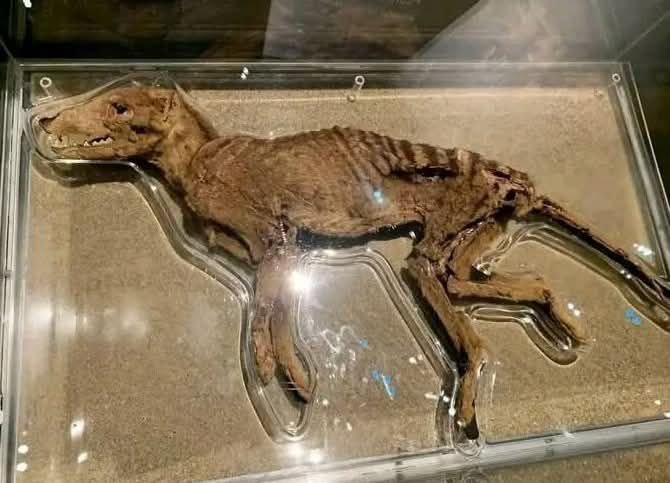
The Tasmanian tiger, also known as the thylacine, is one of the most mysterious animals in modern history. Officially declared extinct in the 20th century, it has long fascinated scientists and the public alike. Imagine, then, the incredible significance of discovering a 5,000-year-old mummified Tasmanian tiger. Such a find would not only reshape our understanding of this elusive creature but also provide valuable insight into Australia’s ancient environment and human history.
The Tasmanian tiger was a carnivorous marsupial that once roamed mainland Australia and Tasmania. With its dog-like body, stiff tail, and distinctive dark stripes across its back, it was unlike any other animal. Although it was hunted to extinction due to human activity, much about its behavior, diet, and biology remains unknown. A naturally mummified specimen preserved for thousands of years would offer scientists an extraordinary opportunity to study the species in remarkable detail.
The mummification of the Tasmanian tiger would likely have occurred due to unique environmental conditions, such as extreme dryness, cold temperatures, or a lack of oxygen. These factors can slow decomposition and preserve soft tissues like skin, muscle, and even internal organs. Unlike skeletons or fossilized remains, a mummy could retain fur patterns, facial features, and stomach contents. This would allow researchers to confirm what the Tasmanian tiger ate, how it hunted, and how it adapted to its surroundings.
Beyond biological insights, the discovery would also shed light on the relationship between early humans and the Tasmanian tiger. A 5,000-year-old mummy dates back to a time when Indigenous Australians had a deep connection with the land and its animals. If the mummy were found near ancient tools, campsites, or rock art, it could suggest cultural significance or interaction between humans and the species. This would help historians and archaeologists better understand how humans may have influenced the tiger’s gradual disappearance from the mainland.