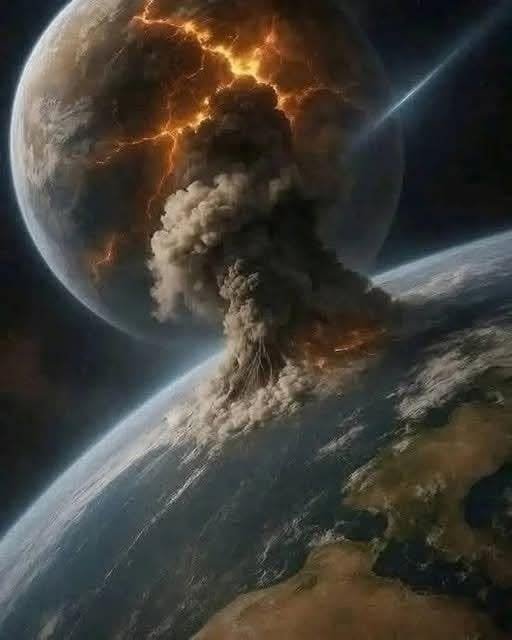
The warning didn’t arrive with dramatic headlines or urgent alarms. Instead, it appeared quietly—wrapped in technical language and calm reassurances. At first, it sounded routine: another space object passing near Earth. But when its size became clear, the perspective shifted. This wasn’t just any rock drifting through space—it was something massive.
The object, known as 52768 (1998 OR2), carries a name that feels distant and clinical. Yet behind that label is an asteroid estimated to be between 1.5 and 4 kilometers wide—large enough to cause global consequences if it were ever to collide with Earth. Objects of this scale are rare, but they belong to a category capable of altering climate, damaging ecosystems, and reshaping entire regions.
Fortunately, there is no immediate danger.
Organizations like NASA track such asteroids with remarkable precision. Using advanced telescopes and orbital models, scientists continuously monitor their paths, calculating trajectories years—even decades—in advance. According to current data, 52768 (1998 OR2) will pass safely by Earth, moving at a speed of about 8.7 kilometers per second. Its projected path keeps it at a comfortable distance, posing no threat of impact. Experts have been consistent: there is no cause for alarm.
**More Than Just a Flyby**
While this asteroid will pass harmlessly, it serves as a reminder of something less comforting—Earth exists in a dynamic cosmic environment. Space is not empty or static. It is filled with objects, some small and harmless, others large enough to cause serious damage under the wrong circumstances.
Humanity’s ability to detect these objects has improved dramatically over the past few decades. Programs dedicated to planetary defense now scan the skies regularly, identifying near-Earth objects and mapping their orbits. Still, this system is not perfect. Detection depends on timing, visibility, and available resources. Some objects approach from angles that make them difficult to spot until they are relatively close. Others may be discovered only years—or even months—before a potential impact.
**Are We Prepared?**
Efforts to develop defensive strategies are ongoing. Scientists are exploring methods such as deflection missions, where a spacecraft could alter an asteroid’s path slightly—just enough to prevent a collision over time. Missions like NASA’s planetary defense initiatives are steps in that direction.
But preparedness is not just about technology. It also depends on global cooperation, funding, and decision-making. Responding to a real threat would require coordination across countries, agencies, and scientific communities. Delays or disagreements could reduce the time available to act.
**A Reminder, Not a Threat**
In this case, the numbers are reassuring. The trajectory of 52768 (1998 OR2) has been carefully studied and confirmed. It will pass at a safe distance, becoming just another entry in the long record of near-Earth encounters.
But its presence still matters. It highlights how much of our safety depends on vigilance—on scientists watching the skies, on systems designed to detect the unexpected, and on the collective effort to prepare for possibilities that may never come, but cannot be ignored.
The real story isn’t this asteroid. It’s the question it leaves behind: when the next object appears—one that doesn’t pass safely by—will we be ready?