Dubai’s Empty Mirage: When Luxury Hotspots Lose Their Shine
For years, Dubai has been marketed as a paradise of excess.
A city where ambition meets luxury, and where every corner promises a lifestyle beyond imagination.
But in 2026, a different narrative is beginning to emerge.

One that questions whether this carefully constructed dream can truly sustain itself.
At the center of this shift stands the iconic Burj Khalifa.
Once a global magnet for the ultra-wealthy, it symbolized the peak of modern engineering and economic confidence.
Today, however, demand for high-end living around the tower is showing signs of weakening.
Property values in surrounding areas have dropped noticeably in a short period, reflecting a sudden cooling of investor enthusiasm.

This is not just a market correction.
It is a signal.
Because in luxury markets, the behavior of the ultra-rich often acts as an early warning system.
When they begin to withdraw, it suggests deeper concerns about stability and future returns.
The situation becomes even more striking when viewed from the coastline.
Palm Jumeirah, once hailed as the “eighth wonder of the world,” now faces mounting challenges.
Luxury villas that once commanded extraordinary prices are experiencing rising vacancy rates.
Owners are quietly exiting, sometimes accepting losses just to liquidate their assets quickly.
Maintaining these properties has become increasingly expensive, particularly as environmental pressures such as sea exposure and infrastructure wear intensify.
The promise of a private paradise is beginning to feel less certain.
Meanwhile, Dubai’s economy reveals its most visible symptoms in an unexpected place—parking lots.
At Dubai International Airport, rows of abandoned supercars have become a symbol of sudden departure.
These vehicles, once representing success and status, now sit idle, covered in dust.
Their presence reflects a deeper truth: when financial pressure rises, even the most valuable possessions can become burdens.
For some, leaving everything behind becomes the fastest path to escape.
Further inland, the impact is equally visible inside the vast halls of Dubai Mall.
With over a thousand retail outlets, it was once a global temple of consumption.
Luxury brands thrived on a constant flow of high-spending visitors.
Now, the atmosphere is shifting.
Foot traffic remains, but spending behavior has changed dramatically.
Tourists come to observe rather than purchase, turning the mall into something closer to a showroom than a marketplace.
And for a structure of such scale, reduced spending creates enormous financial strain.
The cost of maintaining cooling systems, lighting, and staffing remains constant, regardless of revenue.
When income declines, the imbalance becomes unsustainable.
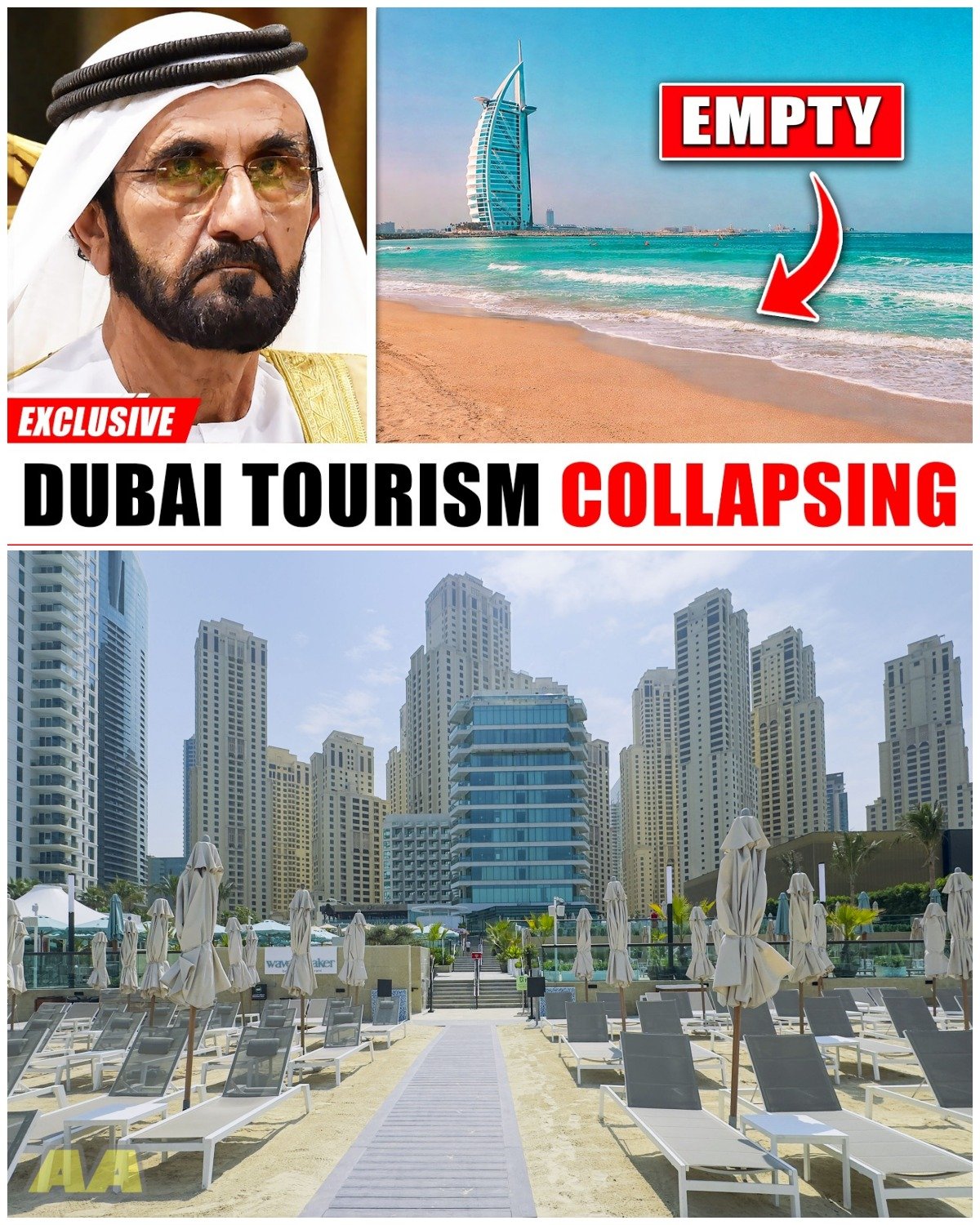
The story continues along the coastline at Jumeirah Beach.
Once a playground for the global elite, it now shows signs of thinning crowds.
Rows of empty sunbeds stretch across the sand, reflecting a shift in traveler behavior.
Luxury alone is no longer enough to guarantee loyalty.
High costs, environmental concerns, and uncertainty are pushing visitors to reconsider their choices.
This decline is not limited to tourism.
It extends into residential areas such as Dubai Marina.
Known for its vibrant lifestyle and dense skyline, the Marina now experiences an unusual quiet.
Apartments remain unoccupied, and “for sale” signs are becoming more common.
Despite efforts to maintain appearances, the reality beneath the surface is harder to hide.
A city built on constant activity cannot easily adapt to stillness.
Yet perhaps the most important story lies beyond the luxury zones.
In areas like Al Quoz, where many workers live, the contrast becomes stark.
While the upper tiers of society have the flexibility to leave, those at the bottom often remain trapped in difficult conditions.
As construction slows and projects stall, uncertainty spreads across all levels of the economy.
This reveals a fundamental imbalance.
Dubai’s success has long depended on a model driven by external demand and transient populations.
Tourists, investors, and expatriates fuel the system.
But when those groups begin to withdraw, the structure faces immediate pressure.
The question is no longer whether Dubai can attract attention.
It is whether it can build resilience.
Because spectacle alone is not enough to sustain a city in the long term.
Stability, community, and sustainability are becoming increasingly important factors in global urban development.
Dubai has overcome crises before, and its capacity for reinvention remains strong.
But the events unfolding in 2026 highlight a critical turning point.
A moment where the city must decide whether to continue chasing spectacle or shift toward a more balanced and durable model.
The skyline still stands.
The lights still shine.
But behind them, a deeper transformation may already be underway.
And the outcome of that transformation will define what Dubai becomes next.